


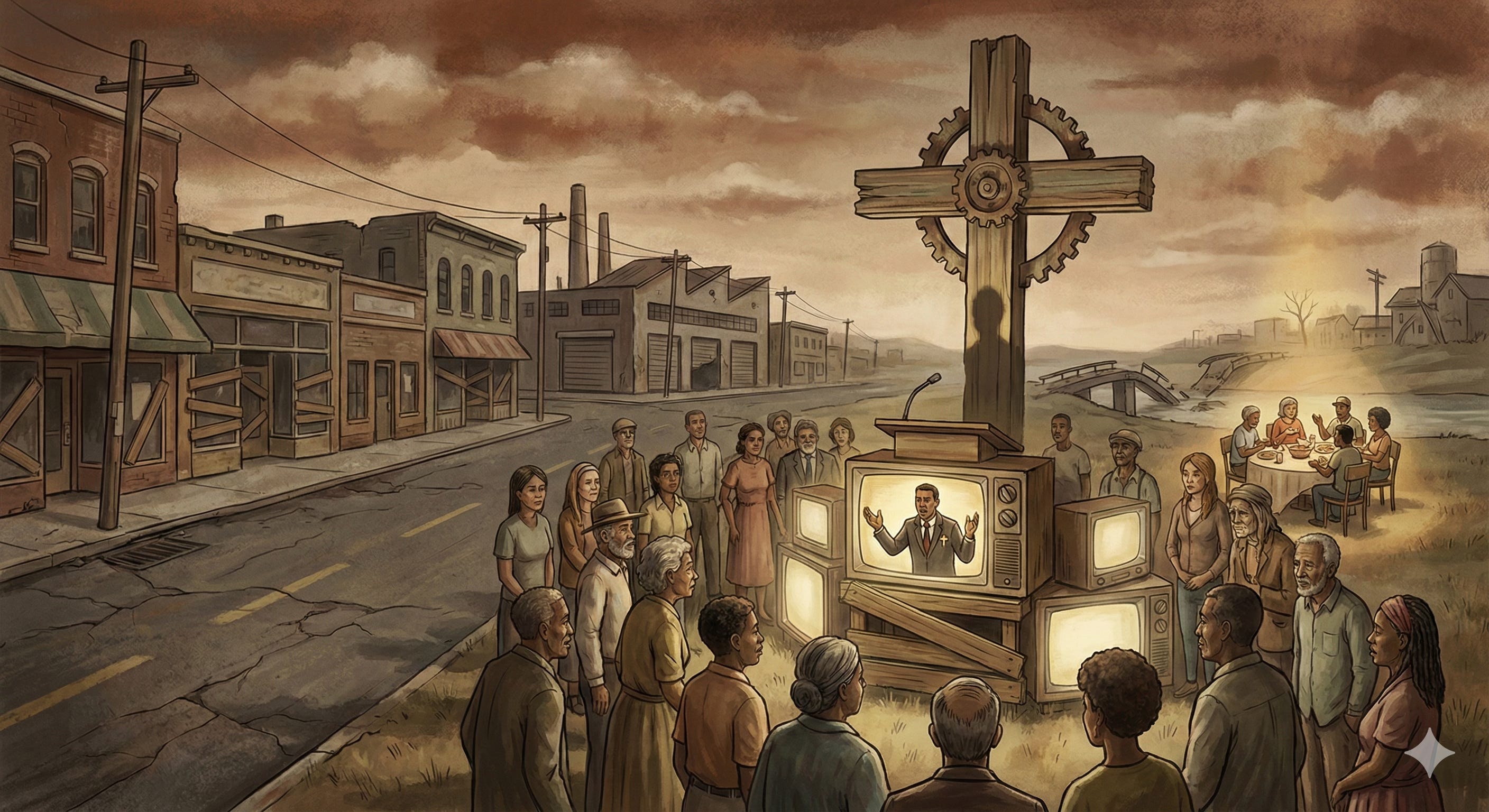
There’s a seduction at work in white America, rarely named but widely felt. It promises meaning to those who feel forgotten, belonging to those who feel displaced, and righteousness to those who feel aggrieved. It takes the chaos of lives that haven’t gone the way anyone expected and offers a new story. And in that story, the seduced aren’t failing; they’re being targeted. They aren’t losing; they’re being robbed. They aren’t becoming obsolete; they’re being pushed out.
These two stories present starkly different realities to live inside. One is pure tragedy, while the other is persecution…and persecution comes with a community of fellow sufferers who see what you see and feel what you feel. It comes with both an enemy and a fight. It comes with grievance.
Grievance, in turn, reinforces belonging. There’s warmth in this circle, even if it’s warmth generated by friction against an outsider. Shared enemies bond people faster than shared hopes ever will. When you’re nursing the same wound and pointing at the same culprits, you don’t have to explain yourself. You’re understood.
Grievance also offers identity. When the old markers of who you are start slipping away, when your job and your town and your place in the culture no longer feel secure, grievance gives you something to hold onto. You know who you are by knowing who’s against you. You know your worth by knowing who’s trying to diminish it.
And grievance offers righteousness. Your anger stops feeling like a personal failing and starts feeling like a moral stance. You’re not bitter; you’re awake. You’re not resentful; you’re refusing to be silenced. The dopamine of righteous anger is neurologically and chemically real. Outrage activates us in ways that grief and self-examination simply don’t.
That, then, is the allure. And we have to understand this grievance isn’t borne from ignorance, nor malice. It’s a genuine offer of meaning, belonging, identity, and righteousness all rolled into one. And until we reckon with the truth of what that gives people, we’ll never understand why it’s so hard to let go of.
This sense of grievance also didn’t emerge from nothing. There’s a real wound underneath the weaponization, and it needs to be named.
Starting in the mid-1970s, the postwar social contract began to unravel. Wages decoupled from productivity, and union membership collapsed from a third of the workforce to less than ten percent today. Manufacturing jobs—the kind that let a high school graduate in Youngstown or Flint or rural Kentucky buy a house, raise a family, send kids to college, and retire with a pension—disappeared or moved overseas or got automated out of existence.
Then the communities built around those jobs hollowed out. Main streets died, and opioids filled the void. Life expectancy for white Americans without college degrees actually started declining, something almost unprecedented in a developed nation. Suicide, overdose, and alcohol-related liver failure all began trending upward. “Deaths of despair,” they called them.
By the numbers, real wages for non-college-educated men have essentially flatlined since the 1970s. Healthcare costs, housing costs, and education costs have all outpaced wage growth dramatically. The floor dropped out for millions of people, and the safety net that might have caught them had been systematically shredded ever since Reagan assured us that government was the problem. And we mustn’t let Democrats off the hook; the party's turn toward neoliberalism and credentialed technocracy in the 1990s left many of these same communities feeling abandoned by both sides, and made the racialized story even easier to sell.
This all hit white working-class communities hard, and it hit them in ways that felt like betrayal. They’d played by the rules, showed up, worked hard, didn’t complain too much…and then someone changed the rules. The American Dream, it turned out, had only been a limited-time offer.
Please understand that I’m not romanticizing this. Plenty of communities have suffered worse for longer with far fewer resources and far less attention. But suffering isn’t a competition. The sense that your children will have less than you did, that your hopes are unattainable and the future you’d planned is slipping away—those things are wounds. None of that makes anyone a hero, but it’s real, and it requires an explanation. The explanations on offer, however, are not created equal.
The first potential explanation is systemic: Deregulation gutted worker protections. Financialization rewarded shareholders over employees. Union-busting became standard corporate practice. Tax policy tilted toward capital and away from labor. Trade deals were negotiated by lobbyists who didn’t particularly care about workers in either country. Wealth concentrated at the top while wages stagnated at the bottom.
All of that is factual; it’s also abstract. It doesn’t give you anyone to blame. You can’t yell at financialization, or rough up a policy paper for your closed factory.
The second potential explanation is “other-ized”: Your jobs went to China. Your taxes go to welfare queens. Immigrants are undercutting your wages and stealing your jobs. Affirmative action gave your kid’s college spot to someone less qualified. The coastal elites care more about Black Lives Matter than about your dying town.
This explanation is simpler, more visceral, and, more importantly, it gives you a face. It gives you someone to point at, someone to curse at, someone to resent. It’s also, wouldn’t you know, the explanation that got funded by think tanks, political campaigns, and media empires with money to make and power to consolidate.
So how did we end up here? It was all part of the plan.
The so-called “Southern Strategy” wasn’t subtle. Richard Nixon and his strategists looked at the civil rights gains of the 1960s and saw an opportunity. White working-class voters, many of them former New Deal Democrats, were unsettled by integration, cultural changes, and a world that seemed to be leaving them behind. Instead of addressing their economic concerns directly, the strategy was to channel that anxiety into racial resentment and wed that resentment to the Republican Party.
Lee Atwater, one of Reagan’s key strategists, explained it with brutal honesty in a 1981 interview. “You start out in 1954 by saying, 'n*****, n*****, n*****.' By 1968 you can't say 'n*****'—that hurts you. Backfires. So you say stuff like ‘forced busing,’ ‘states' rights’ and all that stuff. You're getting so abstract now you're talking about cutting taxes, and all these things you're talking about are totally economic things and a byproduct of them is blacks get hurt worse than whites.”
LBJ, even while coming from the other side of the aisle, put it plainly: “If you can convince the lowest white man he’s better than the best colored man, he won’t notice you’re picking his pocket. Hell, give him somebody to look down on, and he’ll empty his pockets for you.”
This was the misdirection. Real economic pain, caused by policies that favored the wealthy and powerful, got channeled into resentment toward Black people, immigrants, and the poor. The people who actually shipped jobs overseas, who actually busted unions and wrote the trade deals and the tax codes, funded the campaigns that taught white workers to blame their neighbors instead.
And it worked! Not because white workers are stupid; no, it worked because the racialized story was easier to feel, easier to act on, and because the people telling that story had access to airwaves and advertising budgets and political machines that the people telling the systemic story simply didn’t have.
But once grievance takes root, it’s genuinely hard to release. That’s simply how human psychology works.
There’s real relief in righteous anger. Sadness turns inward; anger turns outward and energizes. And there’s something darker: when people feel their worldview threatened, when the culture no longer reflects them back as central, it triggers existential dread. Psychologists call it mortality salience, which is a fancy name for the perception that your way of life, your people, and your story might not persist. Grievance defends against that terror. The alternative (that the world is moving on, and that your grandchildren will inherit something unrecognizable) is too frightening to sit with.
Our chosen communities—especially in this brave new world of social media and influence—reinforce the trap. When everyone around us shares the same narrative, questioning it means risking that belonging. The social cost of rethinking is enormous.
All of that is to say: changing a mind is not as simple as winning an argument. We can’t just throw facts at people and hope they’ll “see the light.” You can show people economic data demonstrating that immigrants don’t actually take their jobs, that Black families receive less government assistance per capita than white families, that the trade deals were signed by politicians they voted for, and it simply doesn’t matter. Grievance isn’t primarily an intellectual position; it’s an emotional and social and psychological one. The question isn’t whether the facts support it but what people would have to feel if they let it go.
And what they’d have to feel is grief. Real grief, for real losses. Grief for the town that died, the job that disappeared, and the future that will never come. Grief without an enemy, without anyone to blame. That’s so much harder than anger.
And let’s be honest, churches have played an important role in this, too, and particularly those of a white evangelical bent. Not all of them; certainly, there are those who've fought this current, sometimes suffering mightily for it. But enough have capitulated that the pattern demands examination. So, just how did these churches become complicit in this? How did a faith tradition that worships a brown-skinned refugee executed by the state become the spiritual home of white grievance politics?
The answer is that certain strains of American Christianity provided the perfect theological infrastructure for grievance to flourish.
The “prosperity gospel” laid the groundwork: if God blesses the faithful with material success, then material struggle must mean something. Either you lack faith, which is too painful to accept, or someone is blocking your blessing. The prosperity gospel created a theology where economic anxiety becomes spiritual warfare. Your financial struggles aren’t the result of policy decisions made by powerful people; they’re the result of spiritual enemies trying to steal what God promised you.
The persecution narrative, meanwhile, was already in place. White American evangelicalism has been cultivating a sense of embattlement for decades: the War on Christmas, the removal of prayer from schools, the secular humanist agenda, etc., etc. Long before economic anxiety reached its current pitch, churches were teaching their members that Christians were the real victims in American society, that their faith put them at odds with a hostile culture, and that faithfulness would cost them.
This was always somewhat strange given that Christians have been and remain the overwhelming majority in America. Christian politicians dominate government, churches are tax-exempt, and “In God We Trust” is even printed on our currency. But theological narratives needn’t be accurate to be powerful. When economic decline arrived, the persecution framework was ready and waiting. It just needed new content.
So, Christian nationalism stepped in to provide that. The idea that America was founded as a Christian nation, and that it has a special covenant with God, makes any loss of cultural centrality feel like cosmic theft. If America is ours by divine right, then demographic change is an assault on God’s plan. If the founders were doing God’s work, then those who want to reinterpret or move past the founding vision aren’t political opponents; they’re enemies of the faith.
Christian nationalism gave white grievance a sacred canopy. It transformed political resentment into holy obligation and made the defense of white Christian cultural dominance feel like faithfulness to God.
The theology of spiritual warfare, in turn, personalized the enemies. When you believe that the world is a battleground between God and Satan, and that demonic forces are actively working against the faithful, political opponents stop being fellow citizens with different views and become agents of the Enemy. They become evil incarnate. Compromise becomes capitulation to darkness, and coexistence becomes collaboration with the demonic.
This is why people who claim to follow Jesus can support policies of stunning cruelty toward immigrants, toward the poor, and toward the vulnerable, and feel righteous while doing it. The theology has sacralized the grievance. The resentment has been baptized.
And now we’ve arrived at the place where all of this cashes out: a political arena where economics became identity, identity became politics, and politics has become a kind of religion unto itself.
For millions of white evangelicals, politics now performs the functions that faith used to serve. It provides meaning, community, identity, moral clarity, a narrative of good versus evil, and a vision of salvation and damnation. It has its saints and martyrs, its sacred texts, and its rituals and revivals.
And into this environment walked Donald Trump. Trump didn’t create white grievance, to be sure, but he propelled himself to power by recognizing it, naming it, and offering himself as its vessel.
Where previous Republican candidates spoke in dog whistles and policy abstractions, Trump spoke plainly: You’re being screwed. They’re laughing at you. They think you’re deplorable. I’m the only one who sees you, and I’m your revenge.
His isn’t a policy platform; it’s an emotional transaction. And it works because the grievance was already there, already theologized, already sacralized, and just waiting for someone shameless enough to say it out loud.
Trump amplifies grievance. Every rally, every post, and every manufactured outrage reinforces the sense that the faithful are under siege, that enemies are everywhere, and that only he stands between his people and annihilation. The persecution narrative requires constant feeding, so he provides constant enemies: the media, immigrants, Democrats, RINOs, the deep state, trans people, universities, prosecutors. The list regenerates endlessly because the grievance can never actually be satisfied, only stoked.
This, you see, is why his legal troubles strengthen him with his base. Every indictment is proof of persecution. The worse things get, the more it confirms the narrative. If they’re coming after him this hard, he must be a threat to them. If he’s a threat to them, he must be on our side.
This is all genuinely dangerous for democracy, because democracy requires certain baseline assumptions to function. It requires believing that we share a country with people who disagree with us. It requires accepting that losing an election isn’t an existential catastrophe, and that institutions can mediate disputes fairly. But grievance politics corrodes all of that.
If elections you lose are “stolen,” then only your victories are legitimate. If institutions that rule against you are “corrupt,” then the only trustworthy institution is the leader himself.
What we are watching now, in real time, is a textbook example of how democracies die. Tanks in the street were never required…it’s all just a slow hollowing out of the norms and mutual trust that make self-governance possible. When politics becomes apocalyptic, and every election is a battle between light and darkness, the whole experiment becomes untenable.
For many white evangelicals, Trump has been theologized in ways that make this even more intractable. He’s been cast as Cyrus, the flawed vessel God uses to protect His people. He’s the last line of defense against an America where Christians are persecuted, children are corrupted, and everything our grandparents built is dismantled.
That framing turns political opposition into the ultimate battle. It turns questioning the leader into apostasy. It turns January 6th from a coup attempt into a righteous stand. When your politics has become your religion, you simply can’t afford to be wrong about it. The stakes are eternal.
This is how the seduction works, and it comes with a steep cost.
Grievance costs us the truth. When your sense of self depends on a particular narrative of persecution, facts that contradict that narrative become threatening. The capacity for honest self-examination, always fragile, becomes nearly impossible. You can’t ask “What if we’re wrong?” because being wrong would unravel absolutely everything.
Grievance costs us our neighbors. The tragic irony is that white working-class communities and communities of color share substantially overlapping economic interests. They’ve been hurt by the same policies, and the same concentration of wealth, and the same hollowing out of public investment. A multiracial working-class coalition would be politically formidable, which is precisely why so much money has been spent making sure it never forms. When Black and white farmers briefly united in the 1890s Populist movement, the response was Jim Crow, and a deliberate shattering of exactly the kind of cooperative alliance that might have demanded something different. Grievance served—and serves—as the wedge. As long as white workers can be convinced that their enemies are Black and brown, they won’t notice who’s actually picking their pockets.
Grievance costs us our souls. To live in a state of perpetual resentment is corrosive. It narrows the heart, and makes us smaller, meaner, and more afraid. It turns us into people who can watch children separated from their parents at the border and feel righteous about it. It transforms a faith that says “love your enemies” into permission to break them.
Grievance costs us the future. When all our energy goes into defending what we feel we’re losing, we have nothing left to build what might be possible. Grievance is fundamentally backward-looking: we want what we had; we want what they took. It has no vision for what could be, only resentment for what was lost.
And grievance, ultimately, doesn’t deliver what it promises. The meaning it offers is borrowed from the enemy and disappears when the enemy does. The identity it provides is rooted in fictions. The community it builds is bonded by anger, not love, which means it devours its own when enemies run short. The righteousness it offers is counterfeit; it satisfies in the moment, but is hollow at the core. Grievance promises to honor your pain, but exploits it instead.
So what breaks the cycle?
I don’t fully know. I don’t have a policy proposal that fixes this, or a magic five-step process that’ll make everything right. The forces that created this are vast and they’ve been building for fifty years. They won’t be dismantled by a Substack essay.
But there are things we can do. We can grieve with people instead of at them. We can name the actual villains (not as conspiracy, but as documented history) so that anger has somewhere to go that isn’t a neighbor. We can keep building the multiracial coalitions that the grievance economy depends on shattering. We can starve the outrage machine by refusing to participate in cycles designed to keep us angry and divided.
And there are things institutions of faith could do, if they wanted to.
After all, the gospel certainly has resources. Profound ones. It offers an identity grounded in belovedness. You don’t need to be better than anyone to be precious in God’s sight. It offers a story that doesn’t require enemies to make sense; Jesus consistently refused to play the us-versus-them game, even when his followers desperately wanted him to. It offers a hope that isn’t threatened by demographic change or cultural evolution, because it was never dependent on cultural dominance in the first place.
The early Christians, remember, were a marginalized minority in a hostile empire. They had no political power, no cultural centrality, and no demographic majority. Yet somehow they built communities that transformed the ancient world by simply embodying an alternative. They shared resources across ethnic and class lines, cared for the sick during plagues when everyone else fled, and treated women and slaves with a dignity that scandalized respectable society.
These early Christians weren’t grievance-driven. They were hope-driven, but not by a hope to get back what they’d lost; their hope was rooted in a vision of what God was making possible now and to come.
Today’s churches could be doing this work. Should be doing this work. Some corners of it are, and have been all along. Black churches have largely refused the racialized narrative, for obvious reasons. Mainline Protestants and progressive Catholics have pushed back, sometimes at great cost. Even within evangelicalism, there are voices calling for repentance. But too much of white American Christianity has made a different choice: to baptize the grievance, to bless the resentment, to ride this wave of Christian nationalism instead of naming it as the idolatry it is.
And all of that’s a choice. But it’s not inevitable. It can be chosen differently. I don’t know if it will be, but I do know that despair is a luxury we can’t afford and that the gospel I believe in has outlasted empires before.
So here’s your invitation: refuse to fight in the culture war. Stop needing an enemy. Build something that doesn't depend on loss to know itself.
Understand that the seduction of grievance is real. What it offers is real. The pain underneath it is real.
But so, too, is the possibility of something else.