


This is an excerpt from my forthcoming book, Reclaiming Christianity: A Companion for the Wounded, the Weary, and the Wanderers.
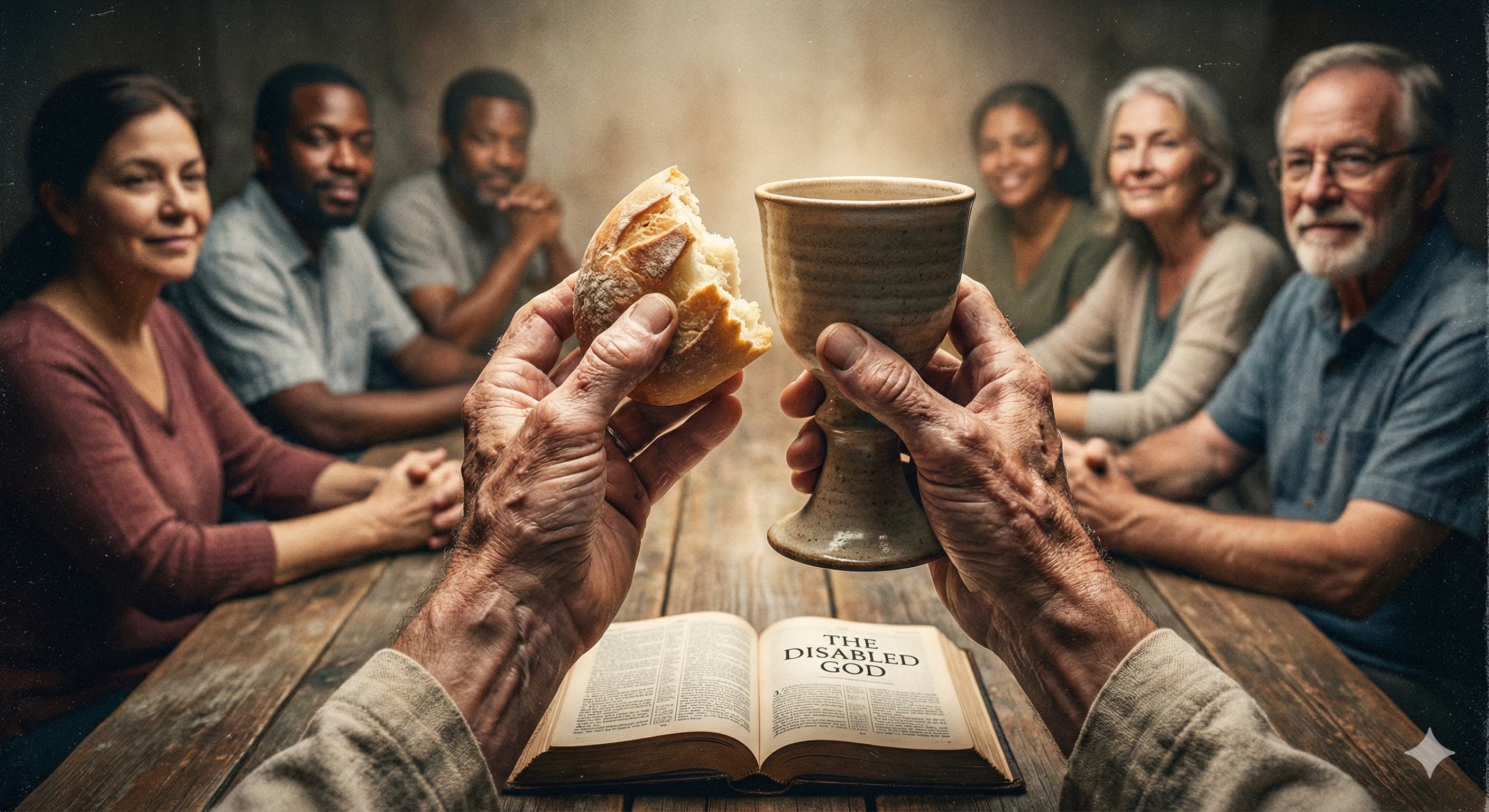
There’s a quiet cruelty buried beneath the Church’s obsession with healing. It’s rarely spoken aloud, and almost certainly never intended, but it pulses beneath our songs, our prayers, our testimonies, and our liturgies. It’s the assumption that frailty must be corrected in order to be holy, and that disability is a temporary condition awaiting divine reversal. It’s an insistence that bodies which don’t function according to cultural norms aren’t yet fully telling the truth of God’s love.
This becomes particularly painful for families raising children with disabilities, or for individuals who live daily with conditions that prayer hasn’t removed. They find themselves caught between competing theological messages: told they’re fearfully and wonderfully made, yet constantly placed on prayer lists for healing; assured that God has a plan for their lives, yet subtly encouraged to view that plan as incomplete until healing arrives.
But scripture tells a more disruptive story, one that resists the equation of disability with deficiency and insists that the presence of God is most clearly seen where the world would least expect it.
In John 9, Jesus and His disciples encounter a man blind from birth. The disciples’ question is immediate: “Rabbi, who sinned, this man or his parents, that he was born blind?” It’s the oldest of interpretive instincts, to seek causality in suffering, to place blame on bodies that deviate from the norm. Jesus rejects the premise outright. “Neither,” He says. And in that moment, He’s dismantling an entire framework. The man’s blindness isn’t a moral failure, nor is it a punishment. There is no puzzle that needs to be explained. It’s simply part of his reality, and Jesus doesn’t ask him to justify it.
What He offers, first and foremost, is presence. The glory of God isn’t always found in the cure; sometimes it’s found in the company.
That company, too, didn’t end at the cross. Disability theologian Nancy Eiesland reimagines the resurrected Christ as One whose body remains marked by crucifixion. The risen Jesus, she argues, is a disabled God—scarred, wounded, and still holy. This insight revolutionizes how we think about bodies and divine presence. If the resurrected Christ retains His scars, then disability can’t be opposed to the image of God.
Eiesland’s disabled God challenges the church’s ableist assumptions at their foundation. When we pray for someone’s healing, are we praying for their flourishing, or are we praying for them to conform to our narrow vision of what bodies should be? When we speak of “making people whole,” whose definition of wholeness are we using? And when we imagine the eschaton, the final restoration of all things, are we envisioning a place where all bodies are “fixed” according to some abstract standard, or a place where all bodies are received in fullness, just as they are?
We are allowed to want relief. There is nothing wrong with praying for healing, with longing for a body that doesn’t hurt or a mind that doesn’t struggle. But resurrection is not the triumph of normalcy; it is the transfiguration of love.
Amos Yong, a Pentecostal theologian whose brother was born with Down syndrome, has argued that disability is an opportunity to reframe theology entirely. In The Bible, Disability, and the Church, Yong insists that we must stop viewing disability through the lens of healing and start viewing it through the lens of hospitality. Instead of asking whether someone might one day be “made whole,” we should ask whether our communities are prepared to receive them as they are. Not hypothetically. Not after enough prayer. Right now.
This shift from healing to hospitality means accessibility becomes more than an accommodation; it becomes a theological imperative. It means that inclusive language stops being about political correctness and starts being about biblical faithfulness. It means that when someone’s body or mind works differently, our first response should be to examine our own barriers instead of praying for their change.
After all, what if inclusion isn't about making room for the disabled person to sit at the edge of a community built by and for the able-bodied? What if it's about recognizing that we're all limited and vulnerable in some way (physically, cognitively, emotionally, socially) and that to be human is to be interdependent? Thomas Reynolds explores this in Vulnerable Communion, writing as both theologian and father to a son with multiple disabilities. The body of Christ, he reminds us, was never meant to be homogenous. Its very power lies in difference.
Paul says this directly in 1 Corinthians 12. “The eye cannot say to the hand, ‘I have no need of you.’” He's not describing a body that merely makes room for its weaker members. He's describing one that can't function without them. The value of a person in the kingdom of God isn’t based on their productivity, their social polish, or their resemblance to some imagined ideal; it’s based on their presence, their belovedness, and their indwelling of the Spirit of Christ.
Disability doesn’t need to be redeemed in order to be sacred. It doesn’t need to be transformed in order to reflect Christ, or to be hidden behind metaphors or softened by euphemism. It needs to be seen, welcomed, and named as part of the body of Christ that already is.
And we don't need churches where disability is prayed away; we need churches where it's honored. Where ramps are not just installed, they're used. Where language doesn't infantilize or erase, where leadership is shared, and where testimony includes the ache that never lifts. Where the Eucharist is offered by hands that tremble. Where the kingdom of God comes through embrace.
Because if Christ is still wounded, then there’s nothing incompatible between brokenness and glory. And if the image of God includes the body of Christ, then the image of God includes every scar, every difference, every limp, every stutter, every delay, and every part of us we were told disqualified us from being whole.
It was never our bodies, you see, that needed healing. It was only our vision.