


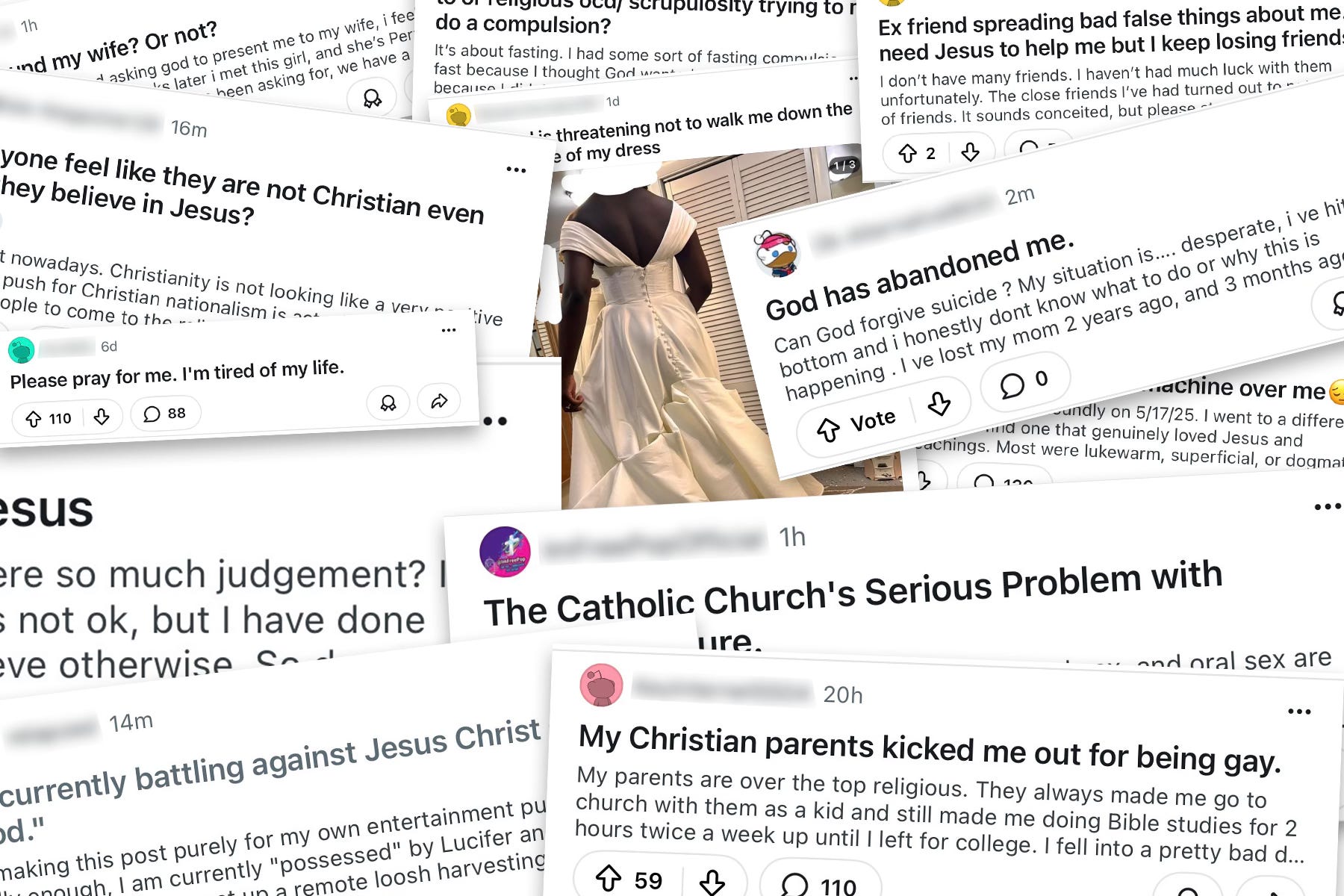
Since last Thursday, I’ve been home recovering from surgery with little to do besides surf the internet. That’s how I ended up on r/Christianity and being taken aback by what I encountered there:
“Please pray for me. I’m tired of my life.”
“God has abandoned me. Can God forgive suicide? My situation is... desperate, i ve hit rock bottom and i honestly dont know what to do or why this is happening.”
There are hundreds of posts like these. People asking questions, sharing struggles, looking for someone to tell them they’re not alone.
“My Christian parents kicked me out for being gay.”
“So my dad is threatening not to walk me down the aisle because of my dress.”
These are things people can’t ask in church. It’s not that they’re inappropriate; it’s that the institution has made it clear there are certain questions that mark you as struggling, doubting. divisive, or dangerous. Ask if God still loves you and you’ll get a meeting with the pastor. Wonder out loud if you’re still Christian because you’re struggling with faith even while you believe in Jesus, and you’ll become a prayer request. Admit you’re tired of your life and you’ll get concerned looks, referrals to counselors, and the quiet sense that your honesty is making everyone uncomfortable.
So people come here instead, to Reddit, to strangers with cartoon avatars and anonymous usernames, to a community of people they’ll never meet, who live in different cities and hold different theologies and probably disagree about half of everything, and they ask their real questions. Can I be gay and Christian? Can I want to die and still be forgiven? Can I believe in Jesus but reject Christian nationalism? Can I love God and still be angry about what the church has done?
And you know what’s remarkable? The community responds. Not always perfectly, and not always wisely. But they show up, bear witness, and say “me too.” They offer reflection and personal stories and sometimes just presence—the virtual equivalent of sitting with someone in their pain without trying to fix it or explain it away. This is the body of Christ doing what the body of Christ is supposed to be doing: bearing one another’s burdens, confessing to one another, and reminding one another that they’re loved. It just doesn’t look like what we thought church was supposed to look like.
Here’s someone asking strangers on the internet if God can forgive them for contemplating suicide. They’ve hit rock bottom, and they’re not going to their pastor or small group because they already know how those conversations will go: the concerned expressions, the gentle but firm reminders about God’s plan, the verses about not losing hope, the subtle implication that real faith wouldn’t ask this question. So they post on Reddit instead, where at least there’s a chance someone will be honest with them, that they might say “I’ve been there” instead of “have you tried praying more,” where responses might include actual theology about a God who understands despair instead of platitudes about joy being a choice.
In a different post, a young woman can’t ask her faith community why her father is threatening to abandon her over a wedding dress. She already knows the answer: modesty matters. Dad is protecting her from causing others to stumble, because this is what godly fathers do. The dress becomes another test of her submission, another way to measure whether she’s really committed to biblical womanhood. So she posts a photo on Reddit and asks: is there actually something wrong with my dress? Is it truly immodest? Am I sinning? And the community, full of strangers who will never attend her wedding, offers something her church can’t: permission to be angry, validation that this is wrong, reassurance that her father’s control isn’t godliness.
Elsewhere, someone’s parents have kicked them out and can’t understand why their gay child is “abandoning God.” They were good parents, after all. They took their kid to church every Sunday, made sure faith was central, did everything right. But somewhere along the way, “everything right” meant choosing purity culture over their own flesh and blood, and now that child is posting on Reddit asking if it’s possible to believe in Jesus without being part of Christianity. The parents still believe the problem is their child’s sin, not the faith that taught them love has limits.
And then over here we have a lesbian who believes in Jesus, yet can’t ask her church why there’s so much judgment. She knows the verses will come out—those verses, the “clobber verses.” The “love the sinner, hate the sin” framework will get deployed, and someone will say they’re just trying to protect her soul. So she asks Reddit instead: why can’t I hold both things together? Why does the church make me choose between my faith and who I am? And strangers—many of whom disagree with her, many of whom hold different views on sexuality and scripture—respond with something her church never offered: the acknowledgment that she’s asking a real question, that her struggle is legitimate, that her faith is genuine even if they don’t share her conclusions.
These are ecclesial questions. These are questions about belonging, about community, about what it means to follow Jesus. People are asking them on the internet because the church has made it clear there’s only one acceptable answer…and that answer requires them to deny their feelings, distrust their experiences, and submit to authority instead of wrestling with what’s holy.
We’ve talked here before about how Americans have stopped going to church. About how Sunday morning used to mean one thing, but now it means brunch or the farmer’s market or sleeping in or scrolling through r/christianity. The Sabbath has been replaced by a dozen other rituals, other rhythms, and other ways of marking the week. And there’s real loss in that. The church once carried people through joy and grief and everything in between, connecting them to something larger than themselves, and giving them language for mystery and transcendence and hope.
But maybe people aren’t leaving because they don’t want community or liturgy or practice; maybe they’re leaving because the church stopped being those things. Maybe it’s no longer a place where people can be honest, where doubt is part of faith, and where you can bring your whole self and still be told you belong. The church’s most basic calling was never to be right about doctrine or to safeguard sexual purity or to win the culture wars; its calling was simpler and harder. To love people. To create space where people could breathe. To bind up the brokenhearted. To comfort those who mourn. To point toward a God who looks like Jesus, the One who touched lepers and ate with sinners and welcomed children and told stories about fathers who run toward their wayward children, not away from them.
Instead, the church has taught people to be afraid—of hell, of demons, of their bodies, of their questions, of the wrong kind of love. It’s taught them that belonging requires conformity, that grace has conditions, and that some people need to change before they’re welcome. So now people are looking for fellowship on Reddit, gathering in web-based spaces to do what the institution wouldn’t let them do: to be real, and to discover they’re not alone.
I scroll on. Someone is asking if their church values the smoke machine more than people. Another is asking if it’s a sin to play Dungeons & Dragons. Someone shares a prayer request for their mother’s cancer treatment. Another asks how to distinguish between God’s leading and religious OCD. Someone celebrates six months sober. Another asks if God still loves them. The ordinary and the desperate, side by side. People trying to navigate faith, doubt, fear, and hope, looking for community, looking for answers, looking for someone to tell them they’re going to be okay…and finding it here, in this strange, screen-bound gathering of people who have nothing in common except the vulnerability they can’t bring anywhere else.
This feels like Saturday morning to me. Not literally, but spiritually: what theologian Shelly Rambo calls the “in-between” time, the day after the crucifixion and before the resurrection, when nothing is resolved and you’re just sitting with the wreckage and wondering what comes next. The day when the disciples are hiding behind locked doors, trying to make sense of what just happened. The day when hope feels foolish and despair feels honest.
Come Sunday, some of these people will go to church, sing the songs and say the prayers and try to find something that feels like hope. Some will stay home, unable to reconcile the Jesus they believe in with the Christianity they’ve experienced. Some will keep scrolling through r/christianity, asking folks they’ve never met if there’s any way to follow Jesus that doesn’t require them to become part of what Christianity has become.
Honestly, I don’t know what happens next. I don’t know if the institutional church can recover from decades of choosing power over mercy, certainty over mystery, and control over grace. I don’t know if the brick-and-mortar buildings can become places where people can ask their real questions again, or if something new is being born online. Perhaps what we’re witnessing here is a reconstruction, a new way to become ecclesia (the called-out ones, the gathered people) in whatever spaces will hold us. Maybe church isn’t a building or a Sunday morning service or even a shared theology, but just people showing up for each other and bearing witness to each other’s pain. Maybe it’s strangers on Reddit telling someone who’s tired of their life that they’re praying for them, that they matter, and that they’re loved.
For the moment, though, we’re still here in Saturday. The damage being done is real, and it’s persistent. So people keep asking their questions in cyberspaces because the church won’t let them ask in physical ones. Parents are still choosing questionable doctrine over their own children. The grieving are still asking if God has abandoned them. And somewhere, in a subreddit with a cartoon robot avatar, someone is typing out a reply: “You’re not alone.”
This is what church looks like now for a growing number of Christians. And Sunday morning is coming, whether anyone shows up to the old buildings or not.