


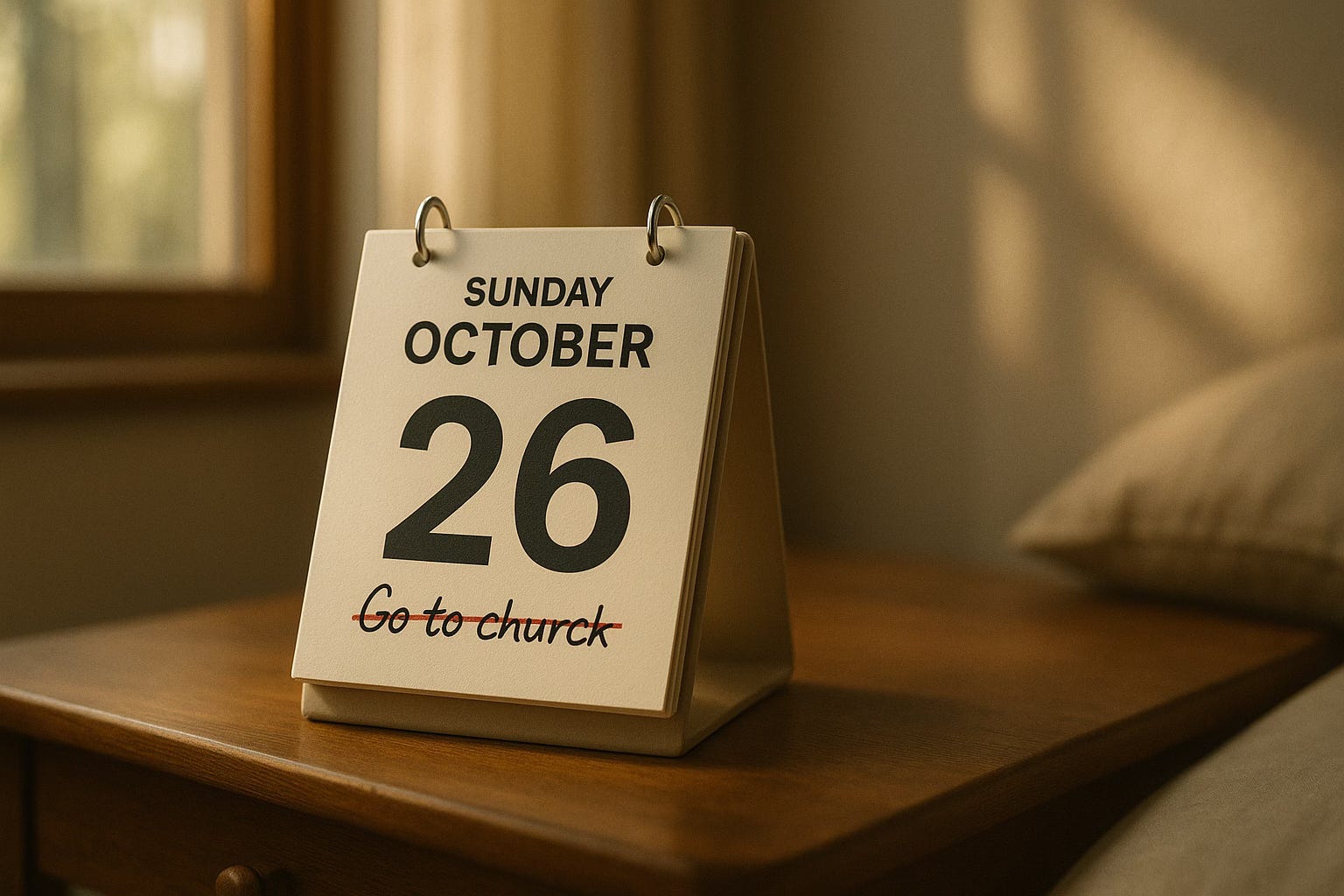
I woke up today later than normal, roused by sunlight streaming through the window. There was no rush to get ready, no schedule to meet, no place I needed to be by a certain time. Just the quiet of the house, the smell of coffee brewing, and the morning stretching out with all its possibilities and no particular plan for what to do with them.
This is what Sundays look like for me now—and for most Americans, if we’re being honest. Church pews are emptying, sanctuaries are quieter, and the morning has become something else entirely. Not sacred time set apart for worship, but open time. Free time. Time we get to decide what to do with, which sounds like freedom until you start to pay attention.
When I was growing up, Sunday meant heading downtown for the weekly service. Not as a choice but as a given, the way Saturday morning meant cartoons and Friday night meant staying up late. It was the day you got dressed in clothes that were slightly uncomfortable, sat in a sanctuary that was slightly too cold or too hot, sang hymns you’d known since childhood, and listened to a sermon that sometimes moved you and sometimes didn’t. Either way, you were there.
It wasn’t always meaningful, and sometimes it was downright boring. It often felt like obligation more than inspiration, ritual without revelation, and going through motions that had lost whatever power they once held. But it was something. A rhythm. A practice. A way of marking time as distinct.
And then, for various reasons, many of us have simply stopped going. Some of us gradually, our attendance getting spottier until it stopped altogether. Some of us dramatically, walking out after a final disappointment or disagreement. Some of us quietly, just drifting away until one day we realized it had been months since we’d been inside a church and we didn’t particularly miss it.
But the morning has remained, and Sundays still carry the echo of being special, even after we’ve stopped filling them with prayer. There’s something about the day itself that makes it feel like this time should matter, that we should be using it in ways that carry weight.
So we try. We’ve just replaced church with other things.
These are the new liturgies, the practices we’ve chosen, consciously or unconsciously, to fill the space that Sunday service used to occupy. And like all liturgies, they’re transforming us.
Youth sports leagues have become religion for a generation of families, creating a certain kind of community centered around children’s activities and achievement. Soccer games and baseball tournaments require the same early rising and gathering that church once did, the same crowd of other parents standing on sidelines, the same rhythm week after week. Parents schedule their entire lives around these commitments with a dedication once reserved for the sacred. There’s genuine connection there, real relationships built on sidelines and in bleachers. But there’s also competition, comparison, the endless pursuit of the next level, the next team, the next tournament. It’s community, but it’s community organized around performance.
Brunch, too, has become its own ritual, forming us into people who value leisurely connection, who prioritize relationships and good food and unhurried conversation. The leisurely meal stretches from late morning into early afternoon, the gathering with friends around tables laden with food that’s more indulgent than what you’d eat on a weekday. The mimosas mark the time as special and celebratory. The conversation meanders naturally, offering the luxury of time spent together without having to rush to the next thing. There’s something genuinely restorative about gathering around a table without agenda, about having time for each other that weekday mornings don’t allow. But it’s also selective, limited to people we already know and like. It’s the comfortable intimacy of chosen family rather than the sometimes uncomfortable breadth of a church congregation that includes people we wouldn’t necessarily choose.
Some of us use the morning to catch up on everything we didn’t have time for during the week: errands and grocery shopping and cleaning the house, practical tasks that Sunday finally provides the space for. The morning becomes utilitarian instead of holy, productive rather than restorative. We become people who are always working, always catching up, and always using available time to accomplish tasks. There’s nothing wrong with productivity, but when even our free time becomes functional and we can’t let a morning just be without filling it with achievement, we’re cultivating a restlessness that can’t tolerate being still.
Others of us sleep in, reclaiming the rest that the work week stole from us. We treat it as permission to do nothing, to let our bodies recover, to simply be horizontal and unconscious for as long as our bodies will allow. This makes us perpetually tired, operating on a sleep debt that one morning a week can’t quite repay. There’s a deliciousness in sleeping late, but there’s also avoidance in the way sleep becomes escape, the morning we spend unconscious rather than facing whatever it is we’re trying not to face.
And many of us scroll through news feeds and social media, through the outrage and anxiety and entertainment that we consume every other morning. But on Sunday it feels different somehow, more desperate maybe, or more empty, like we know this isn’t what we should be doing with this time but we do it anyway because we don’t know what else to do. We are always somewhere else, always consuming, always monitoring what’s happening in the wider world while missing what’s happening in the room where we’re sitting. It’s the opposite of sacred time, the opposite of being present, the opposite of rest. It’s just more of what we do every other morning, the compulsion that follows us even when the morning itself once held different meaning.
I don’t attend church anymore, and I haven’t for a long time. I miss it sometimes, in ways that surprise me. It’s not the specific theology or doctrines, not the sermons or the liturgy or even the worship. What I miss is the rhythm of it, the way it marked time as special, the gathering of people who wouldn’t necessarily choose each other but showed up anyway, the sense that we were all there for something bigger than ourselves even if we couldn’t quite name what that something was.
What I miss is having that one morning a week that felt set apart. That meant something.
We’re all still searching for what that morning used to provide. We’re hungry for renewal that’s deeper than sleeping in. For community that’s broader than our chosen circles. For meaning that stretches beyond our individual lives. For time that feels sacred.
The practices we’ve chosen might satisfy some of that hunger, but I’m not sure they satisfy all of it.
I’m not arguing that we should all go back to church. I can’t go back, not to the church I grew up in, not to institutions that keep failing people in ways I can’t ignore. And I suspect many of you can’t either, for your own good reasons, your own breaking points, your own realizations that you can’t keep pretending to believe things you don’t believe or support structures that hurt people you love.
But I am wondering if we’re being intentional about what we practice on Sundays. If we’re paying attention to how our new liturgies are sculpting us, and whether they are molding us into people we actually want to become.
I don’t have an answer to that. I’m still figuring out what it should be now that it isn’t what it was. But I know this much: we’re practicing something every Sunday whether we mean to or not. And what we practice matters.