


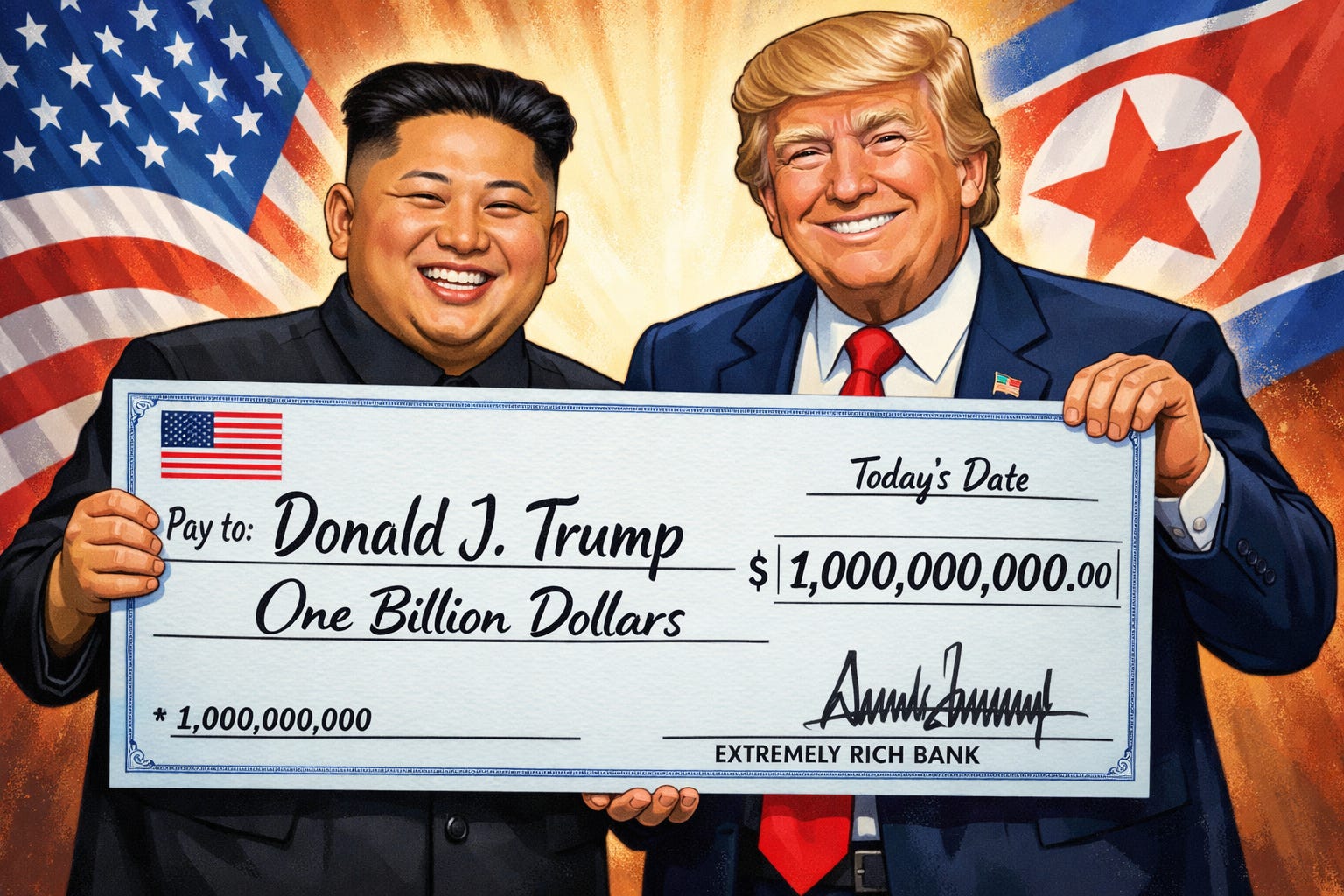
“Watch as Donald Trump takes over the world! Get your seat today for just $1 billion dollars!”
That sales pitch may be made up, but it’s not (entirely) satire. It is, in a nutshell, the idea behind something called the “Board of Peace,” an organization of nation states that Trump now chairs personally, where he retains veto authority over all decisions, final say over interpreting the rules, and apparently direct control over all the money. Countries invited to join get temporary three-year memberships unless they pay at least $1 billion, at which point they become permanent members. The UN Security Council endorsed this arrangement in November 2025.
In the hustle and bustle of the holiday season, most of us missed the announcement. This all came about under the guise of Gaza reconstruction, after all, something that sounds technical and specialized, the kind of diplomatic machinery that hums along after ceasefires without requiring our attention. But here’s what the new organization’s leaked charter says: member states can vote on decisions, but all decisions are “subject to veto by the Chairman at any time thereafter.” The Chairman (Trump) is designated as “the final authority regarding the meaning, interpretation, and application of this Charter.” He decides who gets invited. He approves the agenda. He can remove members. He designates his own successor. He is the sole arbiter of every action (or inaction) undertaken by nations who sign on.
And the terrifying part isn’t that this sounds corrupt or absurd. The terrifying part is that it makes perfect sense once you understand what Trump is building: the replacement architecture for NATO, ready to deploy the moment the old alliance collapses.
Because it’s going to collapse. And Trump is going to collapse it.
NATO has survived for 75 years on a single promise: an attack on one member is an attack on all. Article 5 has been invoked exactly once, by the United States after September 11th, when allies deployed to Afghanistan in support of American operations. But what happens when the most powerful nation decides it isn’t bound by that promise?
Consider Greenland. It’s part of the Kingdom of Denmark, which means it’s technically NATO territory. Trump has publicly discussed wanting to acquire Greenland, sometimes framing it as a purchase, sometimes more ambiguously implying the potential for military action. Let’s say he decides to simply take it. What happens?
Denmark would, presumably, invoke Article 5. There would be emergency meetings in Brussels, strongly worded statements, diplomatic efforts to find an off-ramp. And then…what? Do other NATO members declare war on the United States? Impose sanctions on their own security guarantor? Deploy troops to resist American forces?
Of course not. The moment America becomes the aggressor, the alliance collapses functionally if not formally. For countries like Estonia, Latvia, and Poland (nations that joined specifically because they feared Russian aggression), the message would be unmistakable: the alliance is only as reliable as American restraint, and American restraint is conditional.
Trump doesn’t need to invade Greenland to destroy NATO. He just needs to make clear that he could, that Article 5 doesn’t constrain American action, and that the treaty means whatever he decides it means. Once that’s clear, every member state faces a question: what now?
This is where the “Board of Peace” stops sounding like a bizarre sideshow and starts looking like deliberate design, because here’s what happens when NATO becomes functionally meaningless: the security guarantee that has defined the post-war order evaporates. Smaller nations that depended on American protection through treaty obligation suddenly find themselves vulnerable. European powers scramble to coordinate alternative arrangements (good luck building a European army quickly). Regional powers like Russia and China recognize the opportunity. Then, into that vacuum steps an already-existing alternative, charter drafted, membership terms established, chairman in place.
Think about the incentive structure for a country like Estonia once Article 5 becomes unenforceable. They basically have three options:
Try to build new security arrangements without American involvement. This means coordinating with European allies who have spent decades outsourcing defense spending to the United States, who lack unified command structures, and who can’t agree on threat assessment or strategic priorities. Possible in theory. Unlikely in practice, at least not quickly enough to matter.
Accept vulnerability. Hope that Russia respects your borders out of goodwill or international pressure. Hope that regional powers decide conquest isn’t worth the trouble. Hope that you can negotiate neutrality that satisfies everyone. This is the option nations choose when they have no other choice.
Join the “Board of Peace.” Pay the billion-dollar membership fee. Maintain good relations with Trump personally. Accept that he retains veto authority over any collective decision, that he interprets the rules, that he can remove members who displease him. Accept that your security no longer rests on treaty obligations among equals but on maintaining Trump’s favor and keeping your subscription current.
Option three suddenly begins to look rational when the alternative is worse.
And let’s be clear about what this is: a protection racket. The mafia, of course, pioneered the model. You pay for “protection” (primarily from the people you’re paying). You maintain good relations with the don. You accept that the protection is conditional on continued payment and favor. You understand that falling behind on payments or showing disrespect means you become the target instead of the protected, because the don decides who gets protected and on what terms. The don’s word is final. Cross him and discover that the same power that defended you can destroy you every bit as easily.
Trump’s “Board of Peace” operates on identical principles, just scaled up from Brooklyn to the world stage. Pay the billion-dollar membership fee (your protection money). Maintain good relations with the Chairman (keep “the Don” happy). Accept that protection is conditional on his favor (miss a payment or show disrespect and see what happens). Understand that American power can threaten just as easily as it can defend (the protection is from us, ultimately). The only real difference is that the mafia had the decency not to call it “the Board of Peace” or get UN Security Council endorsement, instead just calling it what it was: how power works when it’s unbound by law. FAFO, as American Secretary of War Pete Hegseth might say.
Here’s what’s being dismantled, and why it matters beyond geopolitics and alliance structures.
The post-war order, for all its profound flaws and hypocrisies, rested on a particular moral claim: that even the powerful would bind themselves to commitments, that military alliances could be built on something more than raw force and national self-interest, and that mutual obligation, however imperfectly honored, could constrain behavior and create predictability. The claim wasn’t that nations always kept their promises (they didn’t, of course) or that treaty obligations prevented all aggression (also didn’t). The claim was that binding yourself to promises mattered, that the constraint itself had value, and that there was moral significance in saying “we will defend you because we promised” rather than “we will defend you if we feel like it.”
Treaties aren’t perfect expressions of mutual obligation, but they at least gesture toward something beyond pure transaction. They create obligations that transcend immediate advantage, and establish that breaking a promise carries strategic (and, frankly, moral) consequences. They assert that even the powerful should be held to the rules they help create.
Trump’s new organization dispenses with obligation. There’s no mutual binding, no constraint on the powerful, nothing meaningful that holds when circumstances change. Just: pay the fee, maintain favor, accept subordination, receive protection (maybe).
The moral difference isn’t subtle. “We will defend you because we made a commitment, and breaking that promise would violate something we claim to value” creates a very different world than “we will defend you if you pay us a billion dollars and stay on our good side.”
And once you abandon your obligation for security alliances, you’ve abandoned obligation everywhere. If the most powerful nation can’t be held to treaties, and every agreement is negotiable based on personal whims and financial incentives, what’s the basis for any international agreement? The foundational principle becomes “the powerful do what they want, and everyone else pays for access.” That’s not governance; it’s a racket with subscription tiers.
Human political orders have always been imperfect, marked by hypocrisy and selective enforcement. But the existence of treaties, international law, and binding commitments at least created the possibility of accountability. They established that nations could be held to standards they claimed to uphold, and made it harder (not impossible, but harder) for the powerful to simply do whatever they wanted without consequence.
The “Board of Peace” does more than ignore these constraints. It formalizes their absence. It announces that the new international order will be built on purchased subordination to personal authority, and makes clear that American power is no longer constrained by the commitments it made when it built the post-war system.
While writing this essay, the argument stopped being theoretical. Today (January 19, 2026) the Kremlin confirmed that Vladimir Putin has been invited to join Trump’s “Board of Peace.” The invitation was extended even as Russia’s war on Ukraine approaches its fourth anniversary, with hundreds of thousands dead and peace negotiations stalled.
Think about that. Trump is inviting the leader actively waging a war of territorial conquest to join his “peace” organization, to sit on the board that will oversee reconstruction and governance. The man who violated Ukraine’s sovereignty, and has made clear that treaty obligations and international law mean nothing when they conflict with Russian interests, is being offered a seat at the table where Trump decides who gets protection and on what terms.
This isn’t a bug in the system. This is the system working exactly as designed. The “Board of Peace” was never about peace; it’s about power unbound by obligation, and it’s about replacing treaty commitments with purchased access to Trump’s favor. If Putin pays the billion dollars, if he accepts Trump’s authority as Chairman, if he’s willing to operate within the structure Trump has built, then his war on Ukraine becomes just another detail to be managed, another issue to be negotiated based on Trump’s personal discretion versus international law.
The post-war international order didn’t just rest on the idea that the powerful could bind themselves. It rested on the idea that aggression itself carried consequences, and violating sovereignty meant isolation and accountability. Trump’s invitation to Putin announces that those consequences are over. Pay the fee, accept the hierarchy, and all is forgiven.
The “Board of Peace” is real, and operational. The charter exists, the UN Security Council endorsed it, countries have been invited. Trump’s authority isn’t speculation; it’s written into the governing document.
And NATO, as we discussed, is dying. Trump has made that clear: the alliance is obsolete, a bad deal, a constraint he won’t accept. Whether he invades Greenland or simply refuses to honor Article 5 doesn’t matter. The end is coming.
So here’s the choice facing every country that depends on American security guarantees: when the old alliance collapses, do you pay the billion dollars or accept vulnerability?
Some won’t pay. But some will. Because when you’re Latvia or Estonia or Poland, and Russia is next door, and Article 5 just became unenforceable, a billion dollars for American protection starts to sound reasonable.
That’s the calculation Trump is counting on. And once enough countries make it, once the “Board of Peace” proves functional, why would it stop at security policy? Trade deals can operate the same way. Climate agreements. Development aid. Every domain of international cooperation restructured around the same principle: pay Trump for access to his decision-making authority, accept his veto, maintain his favor, receive benefits conditionally.
This isn’t the end of American hegemony. It’s the transformation of American hegemony from a system constrained (however imperfectly) by law and treaty into a system constrained by nothing except Trump’s personal discretion and one’s willingness to keep paying.
The post-war international order is ending. The replacement is already built. Active aggressors are getting their invitations.
And seats are still available. Just $1 billion, please.