


I love this country. I feel a need to state that plainly, because what follows will sound to some people like I don’t.
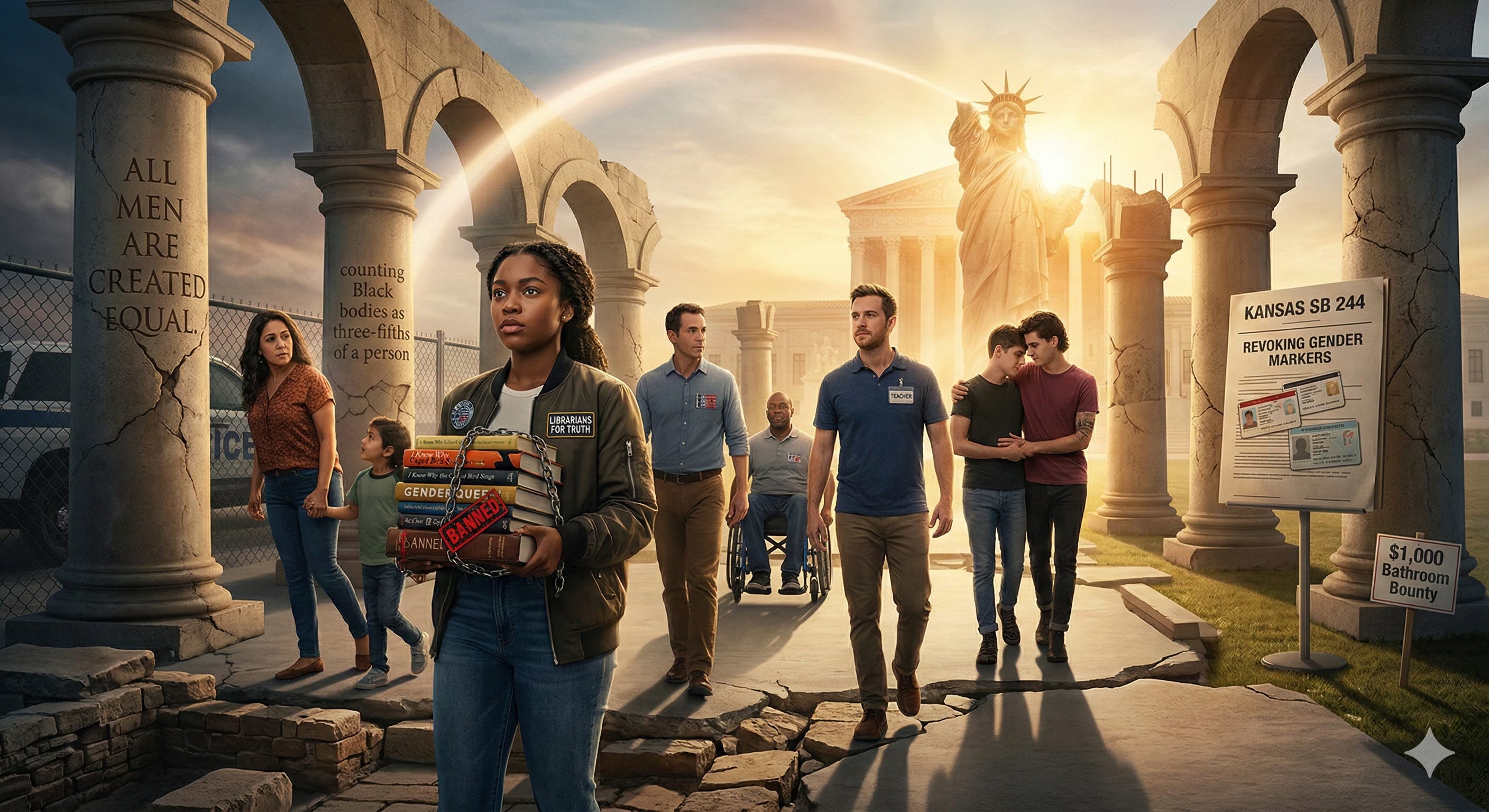
I love the idea of America. I love what she has declared herself to be, even and especially when she fails to live up to it. The promise, though, was always aspirational. “All men are created equal” was written by a slaveholder who went home each evening to a plantation worked by people he owned; the Constitution that enshrined liberty counted Black bodies as three-fifths of a person for purposes of congressional apportionment; and the country that defeated fascism abroad came home and told Black soldiers they couldn’t drink from the same water fountains as the people they’d fought beside.
None of this is news, and none of it negates the promise. It complicates it, the way any honest reckoning complicates the things we love. I don’t love my country less for knowing its failures; I love it the way you love a person whose potential you can see clearly and whose self-destruction you refuse to accept. That kind of love isn’t comfortable, though, and it doesn’t get to look away. It demands something of you. It demands honesty.
So here’s the honest part: what I find most remarkable about the American experiment isn’t where we’ve succeeded; it’s where we’ve failed again and again and kept correcting. Slowly, usually. Reluctantly, nearly always. And almost never without the people most affected by the failure having to drag the rest of us forward.
The Thirteenth Amendment didn’t arrive because our country had a change of heart; it arrived because nearly 700,000 people died in a war and a president was willing to spend political capital on an outcome most of the nation wasn’t ready for. Women didn’t receive the vote because men suddenly discovered their conscience; they won it because women organized, marched, were arrested, went on hunger strikes, and were force-fed in prison until the moral weight of their suffering became heavier than the convenience of their silence. The Civil Rights Act didn’t pass because white America was persuaded by argument; it passed because Black Americans sat at lunch counters and were beaten on bridges and filled jail cells until the evening news made it impossible for the rest of the country to pretend nothing was happening.
Every expansion of American liberty has followed the same pattern: people in power resist, people without power insist, and the promise inches closer to meaning what it says. Love demanded each of those generations’ presence in the gap between who we are and who we said we’d be.
However, this pattern doesn’t only move in one direction. The arc may bend toward justice because people bend it, but when they stop, or when fear overtakes the bending, the arc can snap back with devastating speed.
We are living now through one of those snapbacks.
I don’t believe most of the people driving this are evil, but I do think they’re afraid. Afraid of an economy that no longer guarantees what their parents had, and a culture shifting faster than their frameworks can accommodate. The world they understood is changing, and the certainties that held it together are dissolving, and that’s terrifying. Fear is a legitimate emotion, and I won’t pretend I don’t understand it. I grew up conservative and Republican in Ohio; I know what it feels like to watch the cultural ground shift beneath your feet and conclude that something precious is being taken from you.
But fear, left unexamined, becomes cruelty. It rarely happens on purpose, and almost never with full awareness of what it’s doing, but the result is reliable. When people are frightened enough, they will accept almost any target for their anxiety, and the people most often chosen as targets are the ones with the least power to fight back. This has always been true. It was true when Japanese Americans were interned during World War II, not because they posed any real threat but because fear needed a face and a body to contain it. It was true when McCarthy convinced half the country that their neighbors were secret communists. It was true when states passed anti-sodomy laws that criminalized the private lives of gay Americans well into the twenty-first century, long after most of the country had stopped caring who loved whom.
Fear asks nothing of us except surrender. Love asks everything. And right now, love is asking us to pay attention.
Nearly 23,000 books have been pulled from public school libraries since 2021, most of them for the crime of acknowledging that race, sexuality, and gender exist in forms that make some of us uncomfortable. Utah and South Carolina have created statewide “no read” lists that ban titles from every public school at once. The federal government removed nearly 600 books from schools on military bases under executive orders targeting what it called “un-American” thinking, including Maya Angelou’s classic I Know Why the Caged Bird Sings. Federal workers have been fired simply for having once held positions with the words “diversity” or “equity” in their titles, even after they’d moved to entirely different roles.
Elsewhere, ICE has rescinded the longstanding policy that kept immigration agents out of schools, churches, and hospitals, and student absences in California’s Central Valley spiked 22 percent after raids swept through farming communities where parents were afraid to drive their children to class. In Charlotte, North Carolina, more than 30,000 students stayed home in a single day while a federal enforcement operation swept through their city. Thirty-two people died in ICE custody in 2025 alone, the agency’s deadliest year since 2004.
And then there’s Kansas, which may be the most precise illustration of what this snapback looks like when it reaches the level of individual lives.
Today, transgender people across the state are receiving letters from the Kansas Division of Vehicles informing them that their driver’s licenses are no longer valid. Not suspended or under review; invalid. Effective immediately, with no grace period, because the state legislature didn’t bother to include one.
Senate Bill 244, which Governor Laura Kelly vetoed and which the Republican supermajority overrode, requires all Kansas-issued identification documents to reflect sex assigned at birth. It retroactively invalidates every gender marker change made since 2007, revoking roughly 1,700 driver’s licenses overnight and nullifying just as many birth certificates. The bill was rushed through using a procedural maneuver called “gut and go” that bypassed nearly all public input on its key provisions. The people most affected by the law had almost no opportunity to speak before it was passed.
Revocation, though, is only the beginning. The law also creates what critics have called a “bathroom bounty” system, deputizing ordinary citizens as enforcers of restroom use in government buildings. Anyone who believes a transgender person used the wrong facility can file a complaint and collect a thousand dollars in damages. As one trans woman in Wichita told reporters: “It turns Kansas residents into Dog the Bounty Hunter. So now I have to worry about people watching me walk into the ladies’ room.”
Take a moment and consider what this means in the texture of someone’s Thursday morning. A woman in Topeka who has lived as herself for twenty years, whose coworkers know her, whose neighbors know her, whose children call her Mom, now carries an ID that says she’s someone else. Every traffic stop becomes a potential confrontation. Every job application becomes a forced outing. She can’t renew her car registration without presenting a document that contradicts the person standing at the counter. And if she’s pulled over without a valid license, she faces a class B misdemeanor carrying up to six months in jail (in a state that requires its county jails to house inmates by sex assigned at birth).
If you love this country, you have to be willing to look at that and call it what it is. It’s not governance. It is the machinery of erasure, dressed in bureaucratic language and given the force of law.
Love demands more than grief at these sort of injustices, though. It demands we remember that history cuts both ways.
Every one of these snapbacks has eventually broken. Japanese internment ended, and decades later the country apologized and paid reparations, inadequate though they were. McCarthyism collapsed under the weight of its own cruelty when Joseph Welch looked at the senator on live television and asked, “Have you no sense of decency, sir?” Anti-sodomy laws fell in 2003 when the Supreme Court ruled in Lawrence v. Texas that the state has no business in the bedrooms of consenting adults. Marriage equality, which seemed politically impossible in 2004 when state after state passed constitutional amendments against it, became the law of the land eleven years later. The distance between impossible and inevitable turned out to be shorter than anyone imagined.
They broke because people did what love demanded of them, and what love has always demanded: they showed up. They showed up when it was inconvenient and when it seemed pointless. They sat at counters and marched into fire hoses. They came out to their families over Thanksgiving dinner. They refused, in a thousand small ways, to let the distance between America’s promise and America’s reality become something they could live with.
And you’ll find it happening right now, if you look closely enough. Thirteen states have passed anti-book-ban laws since 2023, protecting librarians and codifying the right to read. Teachers in Chicago and Denver and Charlotte are refusing to hand student records to immigration agents, putting their own jobs on the line to protect children in their care. A teacher in San Diego told reporters she’d sent three students to mental health counselors in a single week because they were terrified their parents would be deported; she kept showing up the next week, and the week after that. In Topeka, the Reverend Dr. Mandy Todd and Rabbi Moti Rieber stood together outside the Kansas Senate chamber in protest of SB 244. In New Jersey, a librarian named Martha Hickson was called a pedophile at a school board meeting, had her car vandalized, received death threats…and kept fighting until her state passed a Freedom to Read Act.
So this is how the arc bends and we become who we promised to be: through the accumulated weight of ordinary people who decide they aren’t willing to look away.
And what is it we’re showing up for? What’s on the other side of this, if we do the work?
I think about that sometimes, simply as an act of moral imagination. The kind that every generation before us needed in order to keep going.
The country we keep promising to be would be one where a woman in Topeka doesn’t have to choose between driving to work and risking arrest. Where a child in California’s Central Valley doesn’t stay home from school because her father is afraid to start the car. Where a librarian in New Jersey can protect a book without risking her family’s safety. Where the phrase “all men are created equal” isn’t an aspiration we shrug at but a debt we’re actively repaying.
It would be a country that tells the truth about its past and lets that truth make it more generous instead of more defensive. A country where fear doesn’t get to choose the targets, where difference is met with curiosity instead of legislation, and where we measure our greatness by how seriously we take the dignity of the most vulnerable among us.
We are not that country. Not yet. We have never been that country. And yet every generation has moved us closer, and every generation has done it the same way: by caring about this place enough to demand more of it.
Because still, after everything, we love her. Still, we show up. Still, America.