


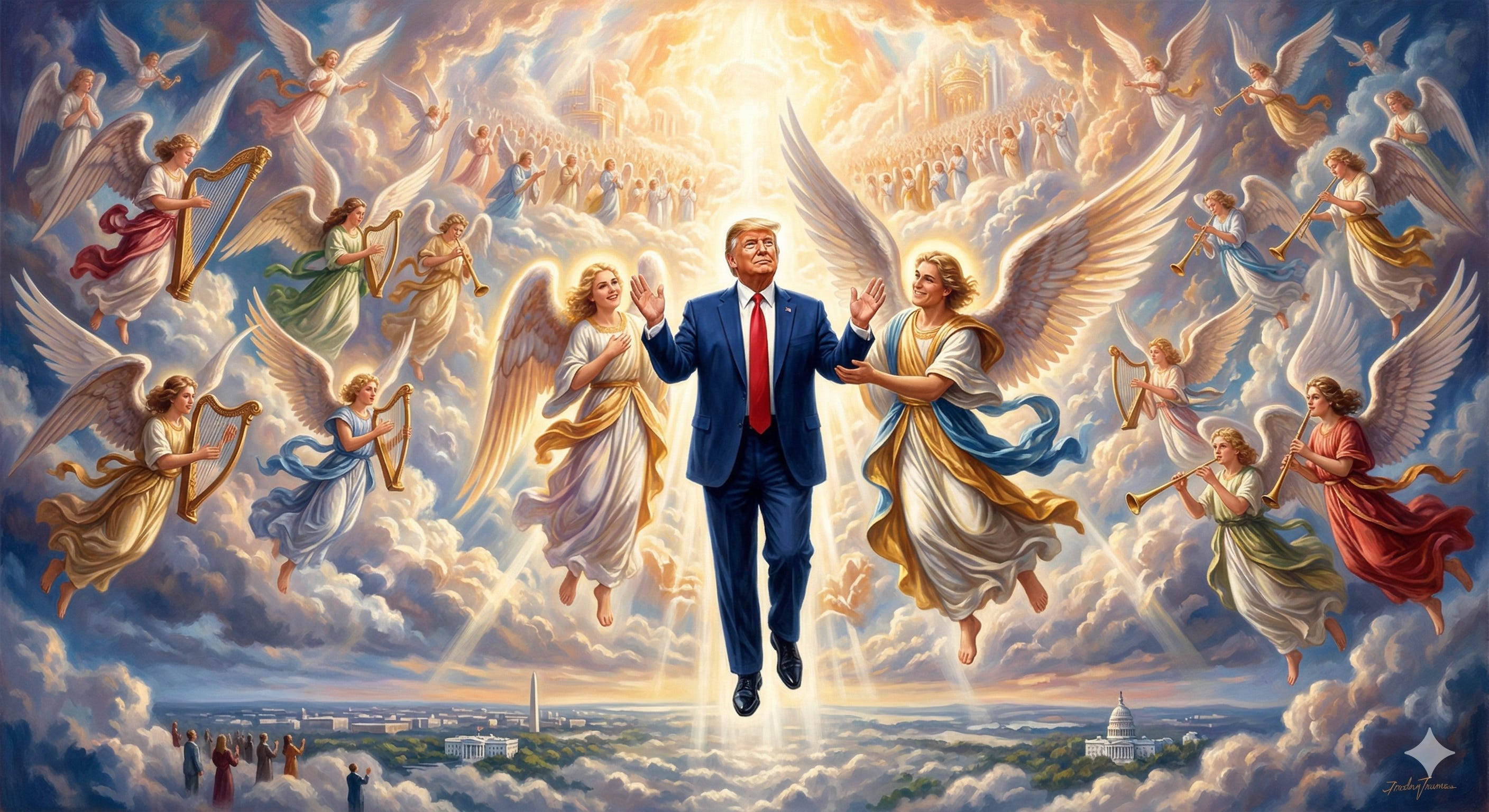
Easter is mere days away, and millions of Americans are busy celebrating their Lord and Savior. They’re circulating images of him at the Last Supper, seated at the center of the table where Jesus sits in every version of that painting anyone has ever seen. They’re sharing paintings of him ascending into heaven, robed in light, angels arrayed around him. They’re offering prayers of gratitude for his sacrifice, for the wounds he absorbed and the persecution he endured so that they might be spared. They call him anointed. They call him sent.
And the candles they’re lighting have his face on them instead of Christ’s.
I’ve gone back and forth as to whether I should publish this. The moment someone like me argues that MAGA Christianity isn’t real Christianity, half the room simply checks out. I mean, I understand why — it reads like I’m running the same plays but from the liberal end of the field, swapping out proof texts and calling it theology. It’s a bit unseemly.
But I’ve been watching this movement for years now, and I can’t call it Christianity-gone-sideways anymore. What I’m seeing is an entirely different religion, one that has borrowed Christianity’s vocabulary and its imagery and its songs so completely that the theft is almost invisible from the inside. Just this week, with Pete Hegseth standing at a Pentagon podium asking God, in Jesus’s name, for “overwhelming violence of action against those who deserve no mercy,” for “wicked souls delivered to eternal damnation,” the borrowed clothing finally slipped, and what was underneath looked nothing like the faith I recognize.
When a movement takes Christianity’s liturgies while hollowing out its substance, the biblical writers have a word for it: idolatry. Yes, that sounds like a flannel-board Sunday school lesson about ancient people bowing before golden statues, but the biblical understanding actually runs much deeper than that, and cuts closer to home. Idolatry is what happens when you give your deepest loyalty to something that isn't God, and then call that thing God anyway. It warps your sense of who you are, what history is for, and what you owe your enemies. The prophet Isaiah mocked the whole business with real bite, describing a man who cuts down a tree, burns half of it to keep warm, carves the other half into an idol, and then bows before something he built with his own hands. The man’s blind to what he’s done, and that’s Isaiah’s whole point. Idolatry works precisely because the idolater never recognizes it as such.
Donald Trump has told white evangelical audiences that he is “taking the bullets, taking the arrows — I’m taking ‘em for you.” He’s using the logic of substitutionary atonement (the theological claim that an innocent person absorbs the punishment everyone else deserved) and he’s used it in those terms more than once. He’s shared posts comparing his legal troubles to Christ’s passion, while fans share images on social media depicting him beside Jesus at the Last Supper or surrounded by angels and ascending into the clouds. His face even appears on prayer candles sold by the thousands. At the Liberty Ball following his second inauguration, a worship artist painted his portrait live while the crowd sang hymns, lifting her arms between brushstrokes as though asking God to guide her hand. Millions of people watched and wept. For them, it was worship, and not in some loose metaphorical sense.
The movement built around that worship has everything a religion needs: a vision of restored paradise (a golden age stolen by enemies, waiting to be reclaimed), sacred sites and martyrs (January 6 chief among them), and now a holy war, prosecuted in the Middle East in Jesus’s name by a Defense Secretary who has declared “no quarter” for America’s enemies, a declaration the Pentagon’s own Law of War Manual explicitly prohibits, and who asked the American people to pray for their soldiers “in the name of Jesus Christ.” It has a savior and a gospel and a cross. What it doesn’t have, and what it has never had, is Christ.
If you want to see how far the distance is between Pete Hegseth’s god and the real one, Palm Sunday is where it becomes impossible to miss.
The crowd that welcomed Jesus into Jerusalem was desperate for a military deliverer. They’d lived under Roman occupation long enough to imagine liberation only in violent terms, and they lined the road and waved branches and shouted the old words for national salvation. Jesus rode in on a donkey, pointedly, in a deliberate refusal of the warhorse everyone expected. Then he went to the Temple and wept in grief for the city that would call for his execution by Friday. “If you, even you, had only known on this day what would bring you peace.” He’s mourning for the very people who are about to kill him.
Jesus carried that posture all the way to the cross, where humanity poured its worst onto an innocent person and he absorbed it without even a word of retribution. “Father, forgive them, for they know not what they do,” Jesus prayed while being nailed to wood. Hegseth’s prayer, meanwhile, asked for wicked souls to be delivered to damnation, and for enemies to be shown no mercy. Every word of it inverts Christ’s prayer.
Pope Leo XIV seemed to have the same thought. Jesus “does not listen to the prayers of those who wage war,” he said, “but rejects them.”
I already hear the pushback, so let’s just address it outright. Yes, the Psalms contain violent language. Yes, David prayed against his enemies. Yes, Hegseth quoted Scripture directly (Psalm 18: “I pursued my enemies and overtook them.”) Fair enough. But the person Hegseth claims to be praying to isn’t David, it’s Jesus, and Jesus was explicit about how we’re to treat our enemies.
In the Sermon on the Mount, he says: “You have heard that it was said, ‘Love your neighbor and hate your enemy.’ But I say to you: Love your enemies and pray for those who persecute you.” And then he explains why, in the very next breath, because God “makes his sun rise on the evil and on the good, and sends rain on the righteous and on the unrighteous.” To be like God, which is what the whole biblical tradition holds up as the point of human life, means extending grace to people who haven’t earned it and may never return it. Blessed are the merciful. Blessed are the peacemakers.
There is no road from the Sermon on the Mount to “no mercy.” You simply can’t get there from here. You have to leave the building entirely, find a different building, and put a cross on top of it. Which, frankly, is what MAGA has done.
The Jesus of the gospels rode a donkey into Jerusalem while the crowd begged for a warrior. He wept over the people who would kill him and prayed forgiveness while they drove the nails in. The god Pete Hegseth addressed at the Pentagon this week asked for every round to find its mark.
They are different gods. And you can only serve one.
Easter is less than a week away. The whole liturgical claim of the season is that death doesn’t get the last word and that it’s possible to start again even after the worst thing has already happened. Christians have believed that for two thousand years. If it’s true, then it’s true for you, too. If you’ve spent years inside a faith that taught you to worship power and call it Jesus, the tomb is open. You can walk out.
That might mean leaving a church, or it might mean staying in one and fighting for it. It will almost certainly mean grief, because letting go of a god you loved, even a false one, costs something. But the Jesus who wept over Jerusalem is still there, waiting on the donkey while the crowd screams for war, mourning for the people who don’t yet know what they’ve lost. He’s always been there. And if this is the week you find your way back to him, you won’t be the first person to do it on Easter.